 10.34920/2181-8207/2024/1-101

Аннотация. В этой статье автор исследует фонды периодических изданий Британской библиотеки, выпущенные тюркскими политиками и интеллектуалами, находившимися в изгнании в 1920-х и 1930-х годах. Прежде чем перейти к обсуждению проблем, возникающих в результате создания метаданных об этих журналах и газетах, даётся краткий обзор истории изгнанников. Автор выделил языки произведений, их транслитерацию, а также поиск точной и достоверной информации о людях и местах, связанных с периодическими изданиями. Это первая статья, в которой публикации в изгнании и их метаданные рассматриваются как интеллектуальное целое, исследующееся, каким образом создание метаданных может предоставить важную информацию историкам тюркских движений. Заканчивается статья обзором возможностей, открывающихся благодаря более глубокой каталогизации публикаций и их содержания.
Ключевые слова: периодические издания; тюркский; история; изгнанники.
Annotation. In this article, I explore the British Library’s holdings of periodicals produced by exiled Turkic politicians and intellectuals in the 1920s and 1930s. I provide a brief overview of the exiles’ history before moving on to a discussion of the issues that spring from creation of metadata about these magazines and newspapers. I highlight the languages of the works, their transliterations, and the hunt for accurate and reliable information on the people and places attached to the periodicals. This is the first article to conceive of the exile publications and their metadata as an intellectual whole, exploring the manner in which metadata creation can provide important information for historians of Turkic exile movements. I end this piece with a look at the opportunities arising from deeper cataloguing of the publications and their content.
Keywords: periodicals; Turkic; Soviet history; exiles
In 1993, my predecessor, Dr. Muhammad Isa Waley, compiled the United Kingdom’s first and only union list of Turkic periodicals. The slim publication was based on holdings at the British Library, the Bodleian Library (Oxford University), Cambridge University Library, and the School of Oriental Studies Library in London. Dr. Waley’s list included issues found in these libraries, as well as their shelfmarks, but no details were provided on the broader production context of the periodicals. Moreover, this metadata was created before the introduction of the Library of Congress’ (LOC) standardized system of Romanization for Cyrillic-script and Arabic-script Turkic languages. Dr. Waley rendered Cyrillic titles with Republican Turkish spellings developed a bespoke Romanization for Ottoman Turkish. Both of these are strategies differ considerably from the schema that we use today to record non-Latin Turkic titles and authors.
Since the list’s publication, considerable work has been undertaken to bring these records into the British Library’s computerized cataloguing system. Titles, authors, and publishers have all been Romanized according to the LOC’s scheme. Additional metadata has been collected from other institutions across Turkey, Russia, Western Europe, and North America. These new records residing in the British Library’s database of printed materials were shared with both the JISC Hub Discover and the Ohio Consortium of Library Catalogues (OCLC). This implies that they can be easily discovered through composite international catalogues, the best known of which is WorldCat.
Within this process, there is a small group of Turkic periodicals that stands out. These are the magazines produced by Caucasian, Siberian, and Central Asian Turkic exiles in Europe and East Asia in the 1920s and 30s. Although included in Dr. Waley’s List, complete metadata regarding these publications is significantly harder to find than Turkish or post-1945 Soviet Turkic newspapers and magazines. In addition, the periodicals pose serious problems for any cataloguer seeking to compile reliable and comprehensible information about language, places of publication, contributors, and titles. In what follows, I will describe some of the efforts to bring these works into the British Library’s catalogue. I will end my piece with the opportunities presented by metadata creation and the in-depth cataloguing and description of their contents.
The Context
After the October Revolution, political conditions in the Russian Empire impelled a prolonged wave of emigration. Hundreds of thousands of Turkic-speakers fled to neighbouring countries to escape brutal repression, forced collectivization, and, in the 1930s, devastating famine. Among these refugees were several dozen intellectuals prominent in the immediate pre-Revolutionary period. Some, such as Mustafa Shoqaev, Gayaz Isxaki, Muhammad Gabdulhay Qurbangaliev, Abdurrashid Ibragimov, Alimercan Topçubaşı, Miryaqub Mehdiyev, Mirza Bala Mehmetzade, Alihan Kantemir, Ahmet Tsalykatty, and Gaydar Bammat left what would become the Soviet Union as the Red Army entered their respect territories. Others, such as Məmməd Əmin Rəsulzadə and Zaki Validov, remained several years longer in their countries of origin under Soviet rule before escaping the Bolshevik party’s grip. By the fleeing USSR, they thereby avoided the fate of those Turkic intellectuals purged and executed during the Cultural Revolution of 1928-32 and the Great Terror of the late 1930s. They lived to document the crushing impact of Stalinist repression on the cultural, intellectual, and social development of Turkic communities under Soviet rule.
Many intellectuals initially found refuge in Turkey, alongside hundreds of thousands of other exiles, a large proportion of them ethnic Russians. Istanbul soon became a centre of exile organization and anti-Soviet publishing. Smaller cities and towns across the country also hosted considerable numbers of refugees, especially those fleeing Soviet authority in the Caucasus. Many prominent figures left Turkey for Western Europe in the late-1920s, including Mustafa Shoqayev and Gayaz Isxaki. They were often encouraged by Polish representatives in Istanbul, Paris, and the Polish Foreign Ministry, including Tadeusz Hołówko. They sought to capitalize on established links with official and unofficial structures across Western and Central Europe, as well as with Turkic exiles already present in France, Germany, and Czechoslovakia.
Paris was a natural centre for activism, given its role in peace talks after First World War and the presence of South Caucasian governments in exile. But the Polish government of Marshal Piłsudski was instrumental in enticing Turkic activists to Warsaw to join forces in the Promethean Union, an anti-Soviet coalition. Piłsudki’s representatives accepted that Paris would remain a nexus of advocacy and organization, including publishing, given its centrality in global diplomatic spheres. But it was very clear that directions and funds went from Warsaw to Paris and Berlin, not the other way around. The Polish-financed intellectuals and activists joined, either explicitly or tacitly, the Promethean Union, a Polish-led collection of non-Russian exiles from the Soviet Union. The Union amalgamated Ukrainian, Belarusian, Karelian, Kalmyk, North Caucasian and, of course, Turkic exiles into a practical, rather than ideological, alliance. The members sought European support for independent non-Russian national states, a so-called sanitary curtain between the Soviet Union and Central Europe.
Other exiles from Istanbul made their way to Berlin, Galați, and Helsinki, in addition to Paris, Prague and Warsaw, either on their own accord or with Ankara’s encouragement. Crimean Tatar exiles benefitted from existing Tatar settlements activities in the Dobruja, a natural base for publishing and political activism. The Turkistan National Committee (Turkiston Milliy Qomitasi; TMQ), meanwhile, sought to open a base of operations in Berlin in the late 1920s. Shoqayev was initially interested in leading the outfit, but his frequent clashes with Zaki Validov meant that other Turkestani exiles were left in charge. They were supplemented by additional waves of exiles after the Turkish government’s suppression of anti-Soviet activities in 1932. Ankara was keen to maintain good relations with its northern neighbour, and an easy way to do this was to quash anti-Soviet agitation. It was at this time that exile magazines and newspapers published in Turkey were shuttered, and the importation of such periodicals from abroad was outlawed.
A third group of exiles, mainly Turkestanis, Tatars, and Bashkirs, fled south and east from the Soviet Union. Unlike the Turkey- and Europe-based groups, these individuals usually retreated with Grigorii Semyonov’s forces. They went deeper into Siberia and eventually Mongolia and Manchuria as the Red Army advanced. Many of these individuals diverged substantially from the Promethean exiles, based largely on their pre-Revolutionary ideas about cultural and political autonomy. They established centres in Afghanistan, India, Manchuria, and Japan, including the first Muslim, Arabic-script press in Tokyo. In the case of Manchurian communities, the groundwork had already been laid by Turkic colonists during the late Tsarist period, many of whom had arrived to work on the Russian-built railroad and associated services. After the Russian Civil War, numerous intellectuals fell under the patronage of the Afghan and Japanese governments. They created a diffuse but active conservative group attached to religious rather than national identity, a stark contrast to the strident nationalism of the Promethean activists.
Linguistic License
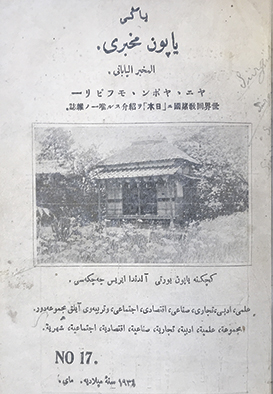
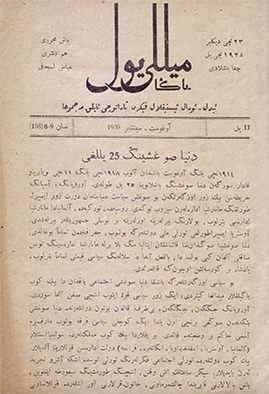
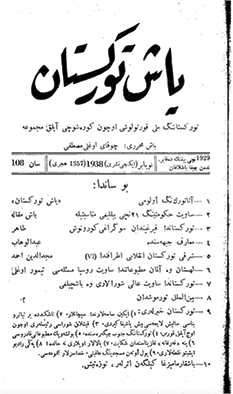
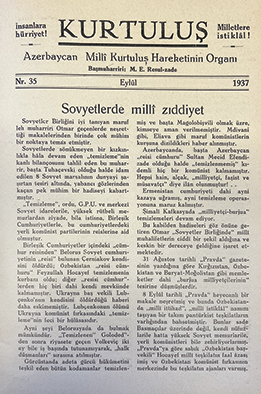
The actions and ideas of the exiles were incredibly varied; so varied that they are far beyond the scope of this article. What I will focus on, however, is the collection of magazines and newspapers that they published across Europe and East Asia. The British Library’s collection contains a healthy selection of these works. They include single or sporadic issues of Yanga Yapon Möxbire (Tokyo), Prométhée (Paris), and a complex spectrum of North Caucasian magazines from Warsaw; microfiches of Milli Bayrak (Mukden, today Shenyang, China); and full runs of Yash Turkiston (Paris), Kurtuluş (Berlin), and Yanga Milli Yul (Berlin/Warsaw). The presence of physical magazines makes it possible to establish preliminary MARC21 and RDA-compliant records for the holdings. But several obstacles remain, complicating the creation of complete and meaningful metadata about the magazine runs.
The first issue that we face when cataloguing is that of language and transcription. Prométhée was produced in French and Kurtuluş and the North Caucasian exile publications were either in Russian, Turkish, or both. None of these pose particular problems, either for establishing language codes or transliteration, in the case of Russian. That, however, is where the easy parts of the task end.
Yanga Milli Yul and Milli Bayrak are clearly Tatar-language periodicals, which makes the assignment of a language code a simple affair. But both were produced in Arabic script according to an orthography that reflects neither traditional Chagatai, Ottoman, or Volga Türki spelling patterns, nor the reformed orthography of the early Soviet period. A bespoke system of transliteration is therefore required. It needs to reflect faithfully the Arabic-script original; allow for intellectual and practical coherence with contemporary Arabic-script experiments; and relate to Latin and Cyrillic Tatar spellings from the 1920s onwards. The solution has been an eclectic and expansive approach in which I transliterate the titles twice: once as if they were Chagatai, and again as if they were written in Cyrillic script. To this, I have added transliterations into Cyrillic, allowing researchers comfortable with contemporary Tatar orthography to find the works without employing transliteration.
The remaining magazines, Yash Turkiston and Yanga Yapon Möxbire, pose additional problems. Neither publication can be folded neatly into a contemporary language category. The former, edited by Mustafa Shoqayev, cannot be described as Uzbek, as it is written in a language that pre-dates Soviet-era linguistic management. But neither is it Chagatai, as it benefits from numerous modifications aimed at bringing it closer to vernacular speech. Shoqayev was a passionate supporter of Turkestani identities and politics. He rejected the Soviet government’s division of Central Asia into national republics. Ahat Andican, in his compilation of articles from the magazine, prefers to identify the language of the publication as Uzbek influenced by the Turkish language revolution. I find this to be incompatible with Shoqayev’s own ideas about Turkestani cultural and political uniqueness and independence. Instead, I opt for describing the language of Yash Turkiston as Turkestani, employing the catch-all ‘Altaic’ (TUT) code. I have opted to transliterate it as if it were Chagatai, and to supplement this with transliteration into standard Latin-script Uzbek. This, I hope, will assist Uzbek readers to find the magazine without learning a bespoke and arcane system of Romanization.
Yanga Yapon Möxbire is the hardest of all magazines to categorize in terms of language. Written largely in Volga Türki or Old Tatar, ‘Altaic’ (TUT) is the only appropriate language category for describing this publication’s language in the MARC21 scheme. No clear system has emerged for transliterating Volga Türki into Latin script, nor to describe its peculiarities. The relative obscurity of the written language in Western European or North American collections and scholarship makes deciphering letter-to-sound correspondences particularly tricky for those of us who use the Latin script. I have opted to transliterate it in much the same way that I have done for Arabic-script Tatar. This is less than ideal, especially given that the primary force behind Yanga Yapon Möxbire, Muhammad Gabdulhay Qurbangaliev, did not identify himself or his movement as Tatar. A Bashkir intellectual and religious leader, he was passionate about protecting Bashkir cultural and political autonomy from Tatar cultural domination prior to his exile. The focus of his magazine and of much of his political activity in exile was the bridging of ethno-linguistic differences in service of Islamic unity. But practicality, in this case, has won out over any desire to craft a system of transliteration true to the ideas and praxis of Qurbangaliev and his supporters. It is my hope that this solution can evolve as the work becomes better known among scholars.
Who, What, Where, When?
Language is not the only sticking point when it comes to metadata creation. Another is place of production. For some periodicals, this is a straightforward question. Milli Bayrak, Yanga Yapon Möxbire, and Prométhée were all clearly published and printed in Mukden (Shenyang), Tokyo, and Paris respectively. The North Caucasian periodicals were obviously produced in Warsaw. But Yash Turkiston, Kurtuluş, and Yanga Milli Yul all present specific difficulties in pinning down their primary points of publication. The editorial address for Yash Turkiston was listed in Nogent-sur-Marne, outside of Paris, while that of the other two was mostly provided as Warsaw. But all three publications list their places of printing as various addresses in Charlottenburg, Berlin, Germany. In the case of Yanga Milli Yul, various early issues also provide Berlin as the editorial headquarters. The creation of accurate metadata requires an untangling of the roles and responsibilities of numerous individuals involved in the production of the magazines. And this, in turn, relies on a deeper understanding of the organization exile communities across Europe and East Asia.
For each periodical, we have clear indications of the Editor-in-Chief: Mustafa Shoqayev, resident in Nogent-sur-Marne, for Yash Turkiston; Məmməd Əmin Rəsulzadə, resident in Warsaw, for Kurtuluş; and Gayaz Isxaki, resident mostly in Warsaw, for Yanga Milli Yul. Each of the periodicals was printed in Berlin and received considerable input from authors in the city or across Germany. Shoqayev relied on his colleagues Tahir Çağatay and Abdulvahap Oktay, Turkestani students-turned-exiles who oscillated between Darmstadt and Berlin. Rəsulzadə was dependent on Hilal Münşi, the head of the Azerbaijani National Centre in Berlin. And Isxaki kept his business even closer to hand, leaving the reins in the capable hands of his daughter Saadet, who became Saadet Çağatay after her marriage to Tahir Çağatay.
In addition to these individuals, Herbert Wolf was consistently listed as the publisher of the works. Despite my best efforts, I have yet to identify precisely Herbert Wolf or ascertain his connections to the Promethean or Turkic exile movements. Such connections might not have existed in any case, as Wolf might have simply been the printer responsible for the physical production of the periodicals. Or his presence might have been essential to ensure the continued legality of magazine production, given that none of the other individuals appear to have acquired German nationality. Such questions are outside the realm of metadata creation, but they go some way to helping us understand how to categorize these elements of the collection and their links to broader publishing histories.
Editors and publishers are only the tip of the iceberg when it comes to participants in the periodical projects. A core group of contributors to each of the magazines can be identified through the tables of contents. The editors and their proxies in Berlin show up frequently, but so do other names of great importance. Ali Merdan Topçubaşı, Alihan Kantemir, Ruqiya Möxammadiş, Saniya Gıyfät, Elmas Yıldırım, Miryaqub Mehdiyev, Mirza Bala Mehmetzade, Balo Bilatti, Ahmet Tsalykatty, and many others are among the usual suspects. They are easy to add to the metadata created. While some feature in the LOC authority listing of author names, other do not. In the latter case, a concerted effort to attach these people to the magazines, and to recognize the depth of their participation, is of great importance in having them enter the authorities at some later point.
Some of these individuals went far beyond the simple role of author or correspondent. Ruqiya Möxammadiş, for example, authored pieces for both Yanga Yapon Möxbire and Milli Bayrak, but she was also instrumental as a translator and typesetter, effectively ensuring the physical production of the issues as well as their intellectual content. Other contributors combined prolific authorship with community organization, undoubtedly an important part of ensuring a healthy readership for the magazines. Recognition of their participation helps link the exile ventures to other publishing histories of the pre-Soviet period and those of the Cold War.
Authors who used their real names were only a portion of the individuals cited as those contributing to these publications. Many articles are attributed to pseudonyms and lakaplar, some of which provided clear indications of the geographic origins of writers. This use of other names is an understandable feature of pieces written by intellectuals who feared the retribution of Soviet authorities. The process also helped to make the exile movements appear more widely supported than they were in reality. The full and accurate attribution of these periodicals is therefore a time-consuming, painstaking task requiring the collection and identification of pseudonyms and lakaplar. The process will likely never be completed given the generic nature of some of these names. Considerable work on this has already been completed by scholars in Azerbaijan, Russia, Turkey, and Uzbekistan, and much more still needs to be done.
The North Caucasian exile periodicals from Warsaw present us with another aspect of multiple identities. In 1932, the Turkish government banned the entry of anti-Soviet publications into its sovereign territory. Some issues of the magazines printed abroad were eventually smuggled into the Turkish Republic. This much is apparent from the printing of letters from readers in Turkey after 1932. For North Caucasian exiles, the alienation from Turkey-based readers was devastating, as North Caucasian diasporas in Anatolia were well-established and well-connected to official circles. The Warsaw-based activists of the Caucasian Mountaineers People’s Party (KDHP) therefore took added measures beyond smuggling. They rebranded.
From 1935 onward, the producers of Şimali Kafkasya decided to print entirely identical editions under different titles: Hürriyet Yolu, Millet Bayrağı, Savaş, Bizim Dilek, Gelecek, İleri, Milli Fikir, Vatan Sesi, Ülkemiz, Çağırış, and Yedi Yıldız are those that have been documented by the late Turkish academic M. Aydın Turan. These titles were in turn banned by the Turkish authorities, which required the continual hunt for new names and, presumably, new nominal editors-in-chief and seats of publication to evade the Turkish censor. The challenge thus becomes how to unite all these publications intellectually, if not categorically, and to reflect the reality of their production through metadata.
New Frontiers
For all its obstacles and difficulties, the project of cataloguing the exile periodicals does present us with many new opportunities beyond metadata creation. The hunt for information and contextualization unites librarians with historians, allowing for the formation of a network of researchers and scholars around the world. This feedback loop ensures that the library catalogue remains in step with developments in scholarship about Turkic exiled intellectuals and communities. It also means that complete corpuses of publications can be established across libraries and archives, permitting scholars and other readers to find and enjoy the complete runs of the magazines. Institutions in France, Germany and Poland have already digitized parts of their holdings, and a complete understanding of the publication runs can only help to build the momentum of this effort. It also means that related exile publications not currently found in OCLC, or in union catalogues, can be connected to these works. Such missing links include the publications from Helsinki and Turku, Galaţi, Cairo, Peshawar, and Delhi.
Beyond metadata, the cataloguing and usage of contents is a new frontier that demonstrates the flexible applications of metadata creation. One is the collation of literary pieces, usually poetry, to enrich the bibliographies of exiled poets and literati. Among the best-documented are the Azerbaijani Elmas Yıldırım and the Tatar Saniya Gıyfät, but other contributors remain to be identified and celebrated. Their contributions to global Turkic literature are essential to understanding the persistence of pre-Soviet forms of expression, and the influence of Turkey-based literary development on other Turkic peoples.
Images are another source of creative expansion. These are infrequently catalogued when found in magazines. Descriptions of the types of imagery and their sources feature rarely in scholarship about any Turkic periodical publications. But the exiled works provide us with fascinating views of worlds now passed. Some periodicals, such as Yash Turkiston, Yanga Milli Yul and Milli Bayrak, contained photographs of exiled Turkestani and Tatar individuals and communities from around the world. The people in them give us an indication about the lives and loves of the people who contributed to the magazines and those who read them. The events, rooms, buildings, and scenery they capture help us to imagine the everyday routines of the exiles and of their impact on the world around them.
Yanga Yapon Möxbire is a treasure trove of such materials documenting Turkic communities in Japan, Korea, Manchuria and elsewhere in China. But it also featured a large volume of photographs of Japanese localities and industries; military and political leaders from Japan, Manchuria, Afghanistan, Java, Saudi Arabia, and East Turkistan; and the Turkic exiles who courted them across much of East Asia. A comprehensive listing of these images will be of invaluable support to scholars working to recover the rich and complicated history of Turkic involvement in East Asian affairs over the first half of the 20th century.
These newspapers and magazines started out as localized products for restricted communities. They have ended up, however, in scattered holdings across Europe, Asia, and North America. Their fates are similar to those of many of their contributors. The cataloguing and sharing of metadata about them will help piece together this important component of Turkic publishing history. With it, we can finally begin to understand the full richness of the anti-Soviet legacy among Turkic peoples around the world.
Primary Sources
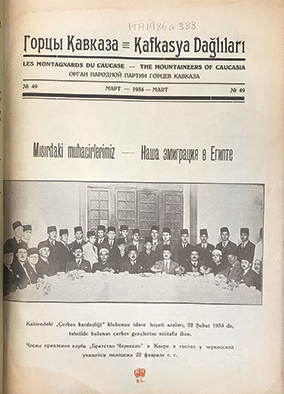
Gortsy Kavkaza = Kafkasya Dağlıları (Paris, 1928-1932; Warsaw, 1932-1934)
Milli Bayrak (Mukden, 1935-1942)
Prométhée (Paris, 1926-1938)
Şimali Kafkasya = Severnyǐ Kavkaz (Warsaw, 1934-1939)
Yanga Milli Yul (Berlin, 1928-1930; Warsaw, 1930-1939)
Yanga Yapon Möxbire (Tokyo, 1930-1938)
Yash Turkiston (Nogent-Sur-Marne, 1929-1939)
Secondary Sources in English
Kuromiya, Hiroaki and Mamoulia, Georges. “Anti-Russia and Anti-Soviet Subversion: The Caucasian-Japanese Nexus, 1904-1945.” Europe-Asia Studies 61, 8 (October 2009): 1415-1440.
Schafer, Daniel. “Reforming the Language of Our Nation: Dictionaries, Identity, and the Tatar Lexical Revolution 1900-1970.”’ In Empire and belonging in the Eurasian borderlands, eds. Krista A. Goff and L. Siegelbaum, 112-128. Ithaca: Cornell University Press, 2019.
Usmanova, Larisa. The Türk-Tatar diaspora in Northeast Asia: transformation of conciousness: a historical and sociological account between 1898 and the 1950s (Tokyo: Radusha, 2007).
Waley, Muhammad Isa. Periodicals in Turkish and Turkic Languages: a Union List of Holdings in U.K. Libraries. Oxford: Middle East Libraries Committee, 1993.
Secondary Sources in Foreign Languages
Abutalybov, Ramiz and Mamulia, Giorgi. Strana ogneĭ v bor’be za scobodu i nezavisimost’: Politicheskaia istoriia azerbaidzhanskoĭ emigratsii 1920-1945 gg. Baku: CBS, 2014.
Andican, A. Ahat. Yaş Türkistan’dan seçilmiş makaleler. Istanbul: Ayaz Tahir Türkistan İdil-Ural Vakfı, 2006.
Babich, IU. L., Gladkova, T. L., and Mnukhin, L. A. Severokavkaztsy v ėmigratsii v XX veke: materialy k biograficheskomu slovariu. Moskva: Direkt-Media, 2020.
Əhmədli, Badirxan. Azərbaycan Mühacirət Ədəbiyyatı: Təşəkkülü Problemləri Şəxsiyyətləri. Bakı: Elm və təhsil, 2017.
Cwiklinski, Sebastian. “Iz istroii Tatarskoĭ pressy i knigoizdatel’skoĭ deiatel’nosti Tatar v Germanii (XX-nachalo XXI vv.).” Tatarica 1,1 (2013): 172-176.
Dündar, A. Merthan. “Uzak Doğu’da İdil-Ural Türklerinin Yayın Faaliyetleri ve Tokyo Mahâlle-i İslâmiye Matbaası.” Türkoloji Dergisi 16, 2 (January 2003): 103-116.
Gasimov, Zaur. Warschau Gegen Moskau: Prometeistische Aktivitäten zwischen Polen, Frankreich and der Türkei 1918-1939. Stuttgart: Franz Steiner Verlag, 2022.
Iskhakova, S. M. Iz istorii rossiĭskoĭ ėmigratsii: pisʹma A.-Z. Validova i M. Chokaeva, 1924-1932 gg. Moskva: Rossiĭskaia akademiia nauk, Nauchnyĭ sovet po istorii sotsialʹnykh reform, dvizheniĭ i revoliutsiĭ, 1999.
Mamoulia, Georges. “L’histoire du groupe Caucase (1934-1939)” Cahiers du monde Russe 48, 1 (2007): 45-85.
Mamulia, Giorgi. Kavkazskaia Konfederatsiia v ofitsialʹnykh deklaratsiiakh, taĭnoĭ perepiske i sekretnykh dokumentakh dvizheniia «Prometeĭ»: sbornik dokumentov. Moskva: Izdatelʹstvo «Sotsialʹno-politicheskaia myslʹ», 2012.
Ono, Ryosuke. “Mühacerattaki Bir Özbek Türkü’nün Mektuplarına Göre Türk Dünyası - Abdülvahap Oktay ve Mektupları.” Ankara Üniversitesi Dil ve Tarih-Coğrafya Fakültesi Dergisi 53, 2 (2013): 563-584.
Penati, Beatrice. “L’emigrazione nazionalista musulmana dall’ex Impero russo in Europa occidentale, 1919-1939.” PhD dissertation. Scuola Normale Superiore, 2008.
Qongyratbai, Tynysbek Ăuelbekūly. “M. Shoqaĭ engbekterīndegī ūlt tăuelsīzdīgī ideiasy.” Türkologiia 1, 105 (2021): 28-40.
Sadykova, Bakhyt. Mustafa Tchokay dans le mouvement prométhéen. Paris: Harmattan, 2007.
Turan, M. Aydın. Kafkasya Dağlıları Halk Partisi periyodikler. İstanbul: Birleşik Kafkasya Derneği, 2000.
Usmanova, Dilara. “Rusyalı Türk-Tatar Göçmenler Tarafından 1930’lu Yıllarda Çıkarılan Basının Tarihi ve Sosyokültürel Kaynak Değeri: Yana Milli Yol ve Yana Yapon Muhbiri.” In XVIII. Türk Tarih Kongresi Kongreye Sunulan Bildiriler (X. Cilt), eds. Semiha Nurdan and M. Özler, 269-280. Ankara: Türk Tarih Kurumu, 2022.
Väliev, Foat. “«Ianga Iapun Mȯkhbire» Măjmugasy.” Kazan Utlary 2/1012 (2007). Last accessed: 17 February 2024. <https://kazanutlary.ru/j-archive/journal-materials/2007-2/yaa-yapun-mokhbire-mmugasy>