
 10.34920/2181-8207/2025/3-185

Abstract: Uzbekistan’s digital transformation, guided by the Uzbekistan 2030 strategy, underscores the urgent need to reform information science education to meet the challenges and opportunities of artificial intelligence (AI). As the country’s flagship institution, the Tashkent University of Information Technologies (TUIT) is uniquely positioned to pioneer these reforms by redesigning curricula and internships that integrate AI across libraries, archives, government agencies, and private information firms. AI technologies are reshaping conventional tasks such as cataloging and information retrieval, requiring students to shift from routine activities to supervising intelligent systems, evaluating outputs, and addressing ethical issues. Simultaneously, AI expands opportunities for experiential learning in data analytics, natural language processing, and digital governance. This paper argues that AI-centric internships can drive societal change by bridging the digital divide and democratizing access to information. Through collaboration with national and international partners, TUIT can establish a transformative model of education that advances Uzbekistan’s modernization and global competitiveness.
Keywords: Artificial Intelligence (AI), Information Science Education, AI-Centric Internships, Digital Transformation in Uzbekistan, Tashkent University of Information Technologies (TUIT), Uzbekistan 2030 Strategy
Аннотация: Ўзбекистоннинг «Ўзбекистон 2030» стратегиясидан келиб чиққан ҳолда рақамли трансформацияси сунъий интеллект (АИ) муаммолари ва имкониятларига жавоб бериш учун ахборот фанлари таълимини ислоҳ қилиш зарурлигини таъкидлайди. Мамлакатнинг етакчи институти сифатида Тошкент ахборот технологиялари университети (ТАТУ) кутубхоналар, архивлар, давлат идоралари ва хусусий ахборот фирмалари ўртасида сунъий интеллектни интеграциялашган ўқув дастурлари ва стажировкаларни қайта ишлаб чиқиш орқали ушбу ислоҳотларга пешқадамлик қилиш учун ўзига хос позицияга эга. Сунъий интеллект технологиялари каталоглаш ва маълумот қидириш каби анъанавий вазифаларни қайта шакллантирмоқда, талабалардан одатий фаолиятдан ақлли тизимларни бошқаришга, натижаларни баҳолашга ва ахлоқий муаммоларни ҳал қилишга ўтишни талаб қилади. Шу билан бирга, сунъий интеллект маълумотлар таҳлили, табиий тилни қайта ишлаш ва рақамли бошқарувда тажрибавий ўрганиш имкониятларини кенгайтиради. Ушбу мақолада таъкидланишича, сунъий интеллектга йўналтирилган амалиётлар рақамли тафовутни бартараф этиш ва маълумотларга киришни демократлаштириш орқали жамиятдаги ўзгаришларга олиб келиши мумкин. Миллий ва халқаро ҳамкорлар билан ҳамкорлик қилиш орқали ТАТУ Ўзбекистоннинг модернизацияси ва глобал рақобатбардошлигини таъминловчи таълимнинг трансформатив моделини яратиши мумкин.
Калит сўзлар: Сунъий интеллект (АИ), Ахборот фанлари таълими, АИ-марказли амалиётлар, Ўзбекистонда рақамли трансформация, Тошкент ахборот технологиялари университети (ТАТУ), Ўзбекистон 2030 стратегияси
Аннотация: Цифровая трансформация Узбекистана, осуществляемая в соответствии со стратегией «Узбекистан-2030», подчеркивает острую необходимость реформирования образования в области информатики для решения задач и использования возможностей искусственного интеллекта (ИИ). Ташкентский университет информационных технологий (ТУИТ), являясь флагманским вузом страны, имеет уникальные возможности для проведения этих реформ, перестраивая учебные программы и программы стажировок, которые интегрируют ИИ в работу библиотек, архивов, государственных учреждений и частных информационных компаний. Технологии ИИ меняют привычные задачи, такие как каталогизация и поиск информации, требуя от студентов перехода от рутинных действий к управлению интеллектуальными системами, оценке результатов и решению этических вопросов. Одновременно с этим ИИ расширяет возможности практического обучения в области анализа данных, обработки естественного языка и цифрового управления. В данной статье утверждается, что стажировки, ориентированные на ИИ, могут способствовать общественным изменениям, сокращая цифровой разрыв и демократизируя доступ к информации. Благодаря сотрудничеству с национальными и международными партнерами ТУИТ может создать преобразующую модель образования, способствующую модернизации Узбекистана и повышению его глобальной конкурентоспособности.
Ключевые слова: Искусственный интеллект (ИИ), образование в области информационных наук, стажировки, ориентированные на ИИ, цифровая трансформация в Узбекистане, Ташкентский университет информационных технологий (ТУИТ), стратегия «Узбекистан 2030»
AI and the Transformation of Information Science Education
Аrtificial intelligence (AI) is reshaping the foundations of higher education, and information science is among the disciplines experiencing the most profound changes (Livi and Salubi, 2024). Traditionally focused on the organization, retrieval, and dissemination of information, the field is now being redefined by intelligent systems capable of automating classification, improving information retrieval, and even generating new knowledge. The integration of AI into education is not merely a matter of adding technical tools; it represents a paradigm shift in how information professionals are trained, the competencies they require, and the ways they engage with dynamic digital ecosystems.
The impact of AI on information science education is multidimensional. On one level, AI is transforming pedagogical methods, enabling personalized learning, intelligent tutoring systems, and adaptive feedback mechanisms that better respond to student needs. On another level, it is reshaping curricula by introducing topics such as machine learning, natural language processing, knowledge graphs, and ethical AI, all of which are increasingly essential for future information professionals (Zeynali-Tazehkandi, Nowkarizi and Budd, 2024). These changes underscore the necessity of moving beyond traditional theories of cataloging and indexing to embrace computational approaches and algorithmic thinking.
At the same time, the incorporation of AI in information science education raises critical challenges. Issues of data ethics, bias, and privacy demand that students not only understand the power of AI but also its limitations and risks. As intelligent systems begin to influence scholarly communication, digital preservation, and knowledge management, educators face the task of preparing students to critically evaluate AI-driven processes while innovating within them. The goal is not to replace human expertise with machines, but to foster a new generation of information scientists who can work collaboratively with AI agents to create more equitable and inclusive knowledge societies.
Beyond reshaping curricula and classroom pedagogy, the influence of AI on information science education also extends to internship programs and fieldwork opportunities for students (Dondlinger and Najmi, 2023). As libraries, archives, and information centers increasingly adopt AI-powered tools for cataloging, knowledge discovery, and user services, students entering these environments encounter a landscape that is more technologically advanced than ever before (Dale, Harlow and Harris Houk, 2022; Yesmin, 2024). This article will specifically examine how such changes affect the design and expectations of internships and fieldwork, exploring how AI alters the skills students must demonstrate, the projects they undertake, and the professional competencies they are expected to master before transitioning into the workforce.
The Impact of AI on Internships and Experiential Learning in Information Science
Internships and fieldwork have always been critical components of information science education, providing students with hands-on experiences that bridge theoretical learning and professional practice (Balbin and Dolendo, 2023; Hora et al, 2021; Wilson, Hawk and Miller, 2023). With the rise of artificial intelligence (AI), these experiential opportunities are being reshaped in ways that open new pathways for skill development, innovation, and professional readiness. AI technologies now permeate libraries, archives, knowledge centers, and information agencies, fundamentally altering both the environment in which students learn and the competencies they are expected to acquire.
One of the most significant impacts of AI on internships lies in the automation of traditional tasks (Jakopec and Aparac-Jelušić, 2023). Cataloging, metadata creation, and indexing – once central duties of interns in libraries and archives – are increasingly being supported by AI-driven tools capable of natural language processing, image recognition, and automated classification. While this reduces the time spent on repetitive tasks, it also shifts the intern’s role toward evaluating AI outputs, improving data quality, and understanding the ethical implications of machine-driven information organization. Such changes give students opportunities to develop analytical, critical, and supervisory skills that align with the future of the profession.
AI also enhances internships by enabling data-driven decision-making and service personalization (Noor Azizi and Kaur, 2023). For instance, library information systems equipped with recommendation engines can guide students in understanding how AI algorithms anticipate user needs and customize access to resources. By participating in the design, monitoring, or refinement of these systems during their internships, students gain valuable exposure to applied machine learning concepts while learning how to balance personalization with principles of intellectual freedom and privacy.
In archives, AI introduces new opportunities for experiential learning in digital preservation and content analysis (Caswell et al, 2024). Tools that use machine learning for optical character recognition (OCR), handwritten text recognition, or predictive analytics allow interns to engage with vast collections that were previously inaccessible. For example, students working with AI-assisted archival platforms can participate in projects that uncover historical patterns, analyze social media datasets, or enrich metadata for cultural heritage preservation. These activities not only improve the quality of archival services but also expand the scope of skills that interns develop in research and digital humanities.
Information agencies and research organizations offer another fertile ground for AI-enabled internships (Mack and Ellis, 2025). Here, students can be involved in knowledge management and information retrieval projects that use AI agents to mine large datasets, detect emerging trends, or support policy-making with evidence-based insights. For example, an intern might work with an AI-powered text-mining system to analyze government reports, identifying patterns that inform development strategies. Such experiences expose students to high-level applications of AI in decision-making contexts, making them more competitive in global knowledge economies.
Beyond specific tasks, AI creates opportunities for continuous learning and skills development during internships. Intelligent tutoring systems and AI-driven training modules embedded in workplace environments can provide real-time feedback to interns, guiding them as they complete assignments. For example, an AI platform could evaluate the quality of metadata entries created by interns and suggest improvements instantly. This dynamic learning approach accelerates the acquisition of new skills and fosters self-directed professional growth.
The integration of AI into internships also supports cross-disciplinary collaboration. Information science students working with AI tools often collaborate with IT specialists, data scientists, and subject-matter experts to refine systems or ensure ethical implementation (Du and Lund, 2023). These collaborative experiences mirror the realities of modern workplaces, where managing information requires teamwork across diverse domains. Interns thus graduate with not only technical competencies but also soft skills such as communication, negotiation, and teamwork, all of which are essential for thriving in AI-driven professional environments.
Finally, the growing presence of AI in libraries, archives, and information centers positions internships as the incubators for innovation and entrepreneurship (Gilstera et al, 2025). Students who engage with AI tools during fieldwork may identify gaps in existing systems or conceive new applications tailored to user needs. For example, an intern might design a chatbot to improve reference services in a university library or propose a machine learning model to optimize digital preservation workflows. Such experiences nurture entrepreneurial thinking and prepare students to become leaders and innovators who can actively shape the future of information services.
Curriculum Reform and AI-Driven Internship Redesign under Uzbekistan 2030
Uzbekistan’s «Uzbekistan 2030» development strategy emphasizes digital transformation, innovation, and the strengthening of human capital as central pillars for sustainable growth (Government of Uzbekistan, 2025). Within this national vision, information science education occupies a pivotal role, as the country seeks to produce highly skilled professionals who can lead the digital economy. However, achieving these goals requires substantial reform of curricula in universities, particularly in institutions like the Tashkent University of Information Technologies (TUIT), which serves as the flagship center for ICT and information science education in Uzbekistan. The demands of a digitally transformed society make it essential to update both classroom teaching and experiential learning components, such as internships and fieldwork (Khan, 2021).
One of the core drivers of reform is the growing reliance on artificial intelligence (AI) in all sectors of Uzbekistan’s economy. As businesses, government agencies, and cultural institutions begin to adopt AI tools for decision-making, data analysis, and service delivery, information science students must be prepared to engage with these technologies. Traditional curricula that focus on cataloging, basic information retrieval, or manual metadata creation are no longer sufficient. Instead, TUIT and other universities must equip students with competencies in machine learning, data science, natural language processing, and digital ethics—skills that are directly applicable to AI-supported internship opportunities.
Internship programs in Uzbekistan can serve as laboratories for testing how AI technologies can improve information services in practice. For example, libraries adopting AI-powered recommendation systems, archives employing machine learning for digital preservation, and government agencies utilizing AI-driven knowledge management systems all present opportunities for interns to gain hands-on experience. Under the Uzbekistan 2030 framework, expanding such AI-supported internships ensures that students do not just learn about AI conceptually but actively participate in the country’s digital transformation agenda.
Another factor driving curricular change is the need for inclusivity and equal access to digital services. Uzbekistan 2030 emphasizes narrowing the digital divide, particularly between urban and rural communities. This goal aligns with rethinking information science curricula to include courses on community engagement, digital literacy training, and AI-enabled public service design. For example, TUIT could integrate internship placements in rural libraries and local government information centers, where students would help implement AI tools for improving access to information. Such programs not only provide experiential learning but also directly contribute to Uzbekistan’s broader development priorities.
The digital atmosphere of Uzbekistan is particularly favorable for this transformation. Rapid expansion of internet access, growing investment in e-government platforms, and national support for ICT development create an enabling environment for experimenting with AI in internships. For instance, initiatives like Kyzmat ID (a unified digital service system) and other e-governance platforms provide fertile ground for information science students to contribute through fieldwork. By involving interns in the optimization, monitoring, or evaluation of such platforms, universities can align educational experiences with national digital priorities.
TUIT, as the leading ICT university in Uzbekistan, has a unique responsibility to spearhead these reforms. Its curriculum must not only incorporate technical courses on AI and data analytics but also restructure internship frameworks to be AI-centric. This means establishing partnerships with libraries, archives, government ministries, and private IT firms that are actively implementing AI tools. Through such collaborations, students would encounter real-world challenges—ranging from algorithmic bias in information retrieval to the ethical implications of automated decision-making—thus preparing them for professional roles that go beyond technical expertise to include leadership and policy understanding.
In addition, TUIT can play a transformative role by fostering research-based internships. Rather than limiting fieldwork to operational tasks, AI-powered internships could include research projects where students evaluate the performance of AI systems, design pilot applications, or develop user-centric innovations. For example, a group of interns might test an AI chatbot designed for university library reference services, analyzing its accuracy, user satisfaction, and cultural appropriateness (Pulido and Orozco-Rodríguez, 2025). This approach integrates research, innovation, and practice—key themes of Uzbekistan 2030.
Curricular reforms must also address the ethical and cultural dimensions of AI in Uzbekistan’s context. Students should be trained to critically assess how AI technologies intersect with local values, language, and traditions. This can be integrated into internships where students evaluate AI tools in real-world environments, ensuring inclusivity and preventing marginalization. For example, interns working in national archives could explore how AI-powered text recognition systems handle Uzbek and Russian languages, identifying gaps and proposing improvements. Such experiences not only enhance learning but also contribute directly to the development of AI systems tailored to Uzbekistan’s cultural and linguistic realities.
Furthermore, internships under the reformed curriculum could emphasize interdisciplinary collaboration, reflecting the Uzbekistan 2030 call for integrated solutions to national challenges. Information science students could be placed in teams with engineers, data scientists, and policy experts to solve practical problems using AI. For instance, they might participate in projects to improve agricultural information systems using AI data analytics, directly contributing to national food security strategies. These interdisciplinary, AI-driven internships would reflect the real demands of a digitally transformed labor market.
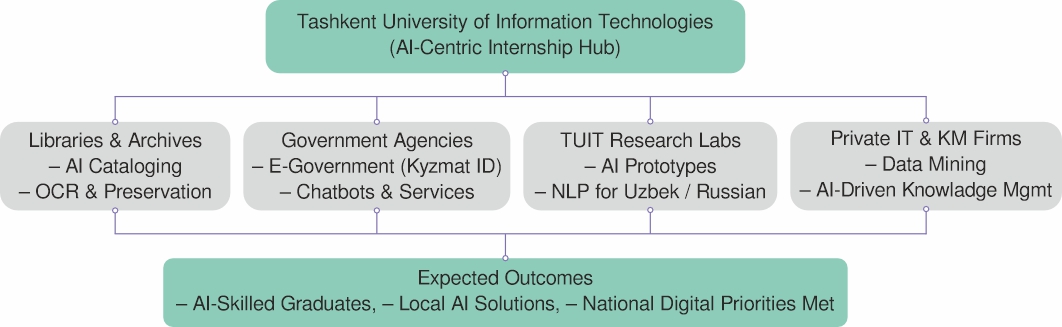
In summary, Uzbekistan 2030 provides both the vision and the momentum for rethinking information science curricula and internship models. TUIT, as the leader in the field, must align its educational strategies with national priorities by embedding AI into both coursework and fieldwork (Diagram 1). By doing so, it will not only prepare students to thrive in AI-enabled environments but also ensure that their internships actively contribute to the country’s digital transformation. This synergy between education and national strategy will produce a new generation of information professionals capable of advancing Uzbekistan’s position in the global knowledge economy while addressing local needs for inclusivity, innovation, and sustainable development. (Diagram 1)
Sample AI-Centric Internship Model for TUIT Information Science Students
1. Internship Goals
Equip students with practical AI-related skills in libraries, archives, government agencies, and private IT firms.
Bridge theoretical knowledge with real-world AI applications in information science.
Prepare students to become agents of digital transformation in line with Uzbekistan 2030.
2. Internship Structure
Duration: 8–12 weeks (final year of bachelor’s or during master’s program).
Placement Areas:
National libraries & archives
Government digital service agencies (e.g., E-Government projects, Kyzmat ID)
University research labs at TUIT
Private IT and knowledge management firms
3. Thematic Modules
A. AI in Libraries and Archives
Tasks: Work with AI-powered cataloging tools, train OCR/handwriting recognition systems for Uzbek & Russian texts.
Outcomes: Improved metadata quality, enhanced digital preservation workflows, multilingual search capabilities.
B. AI for Knowledge Management in Agencies
Tasks: Assist in deploying AI agents for citizen services (chatbots, recommendation systems).
Outcomes: Faster service delivery, reduced information bottlenecks, hands-on experience with NLP.
C. Data Analytics & Policy Support
Tasks: Use AI tools for data mining and visualization to support decision-making in ministries or NGOs.
Outcomes: Reports on patterns in healthcare, education, or agriculture datasets that align with national priorities.
D. Research-Based AI Projects at TUIT Labs
Tasks: Develop or test experimental AI applications (e.g., smart search engines for Uzbek-language corpora).
Outcomes: Research papers, prototypes, or student-led innovation competitions.
4. Skills Students Gain
Technical Skills: AI/ML basics, NLP, data analysis, metadata automation.
Professional Skills: Problem-solving, teamwork with IT experts, project management.
Ethical & Cultural Awareness: Understanding AI bias, privacy, and designing AI systems for Uzbekistan’s multilingual, multicultural society.
5. Assessment & Feedback
Daily/Weekly AI-driven monitoring: AI platforms provide feedback on task quality (e.g., metadata entry, chatbot responses).
Supervisor evaluations: Human mentors assess creativity, collaboration, and problem-solving.
Final project/report: Students present AI-related contributions (e.g., a chatbot, a digital preservation model, or a policy brief).
Conclusion: TUIT as the Pioneer of AI-Centric Internship Transformation in Uzbekistan
The Tashkent University of Information Technologies (TUIT) occupies a unique and strategic position in Uzbekistan’s higher education landscape as the country’s flagship institution for information science and digital innovation. Within the framework of Uzbekistan 2030, TUIT is not only expected to deliver technical expertise but also to lead the transformation of information science education to meet the demands of an AI-driven society. Its pioneering role places it at the forefront of redefining how curricula, internships, and fieldwork are designed, ensuring that students graduate with competencies that directly contribute to the country’s digital transformation.
One of the key takeaways is that TUIT has the capacity to integrate AI technologies into its internship models, offering students direct exposure to real-world challenges in libraries, archives, government agencies, and private firms. By doing so, the university can move beyond traditional knowledge transmission toward experiential, hands-on training that equips graduates to evaluate, improve, and even innovate AI systems. This shift will prepare students not only as consumers of technology but as active contributors to the development of Uzbekistan’s digital ecosystem.
Another important insight is the potential of AI-centric internships to bridge societal gaps. Uzbekistan continues to grapple with issues of digital divide, unequal access, and limited digital literacy in rural areas. By redesigning internship programs that incorporate AI tools for digital preservation, multilingual information retrieval, and public service delivery, TUIT can prepare students to become mediators of societal change. These graduates will help democratize access to information, expand opportunities for marginalized communities, and align with the inclusive development goals of Uzbekistan 2030.
Moreover, TUIT’s leadership role extends to interdisciplinary and cross-sector collaboration. AI-centric internships designed in partnership with government ministries, international organizations, and private industry can serve as platforms for collaborative innovation. Students who work in such environments will develop not only technical skills but also competencies in teamwork, policy understanding, and ethical decision-making. This prepares them to operate at the intersection of technology, society, and governance—an area of growing importance in Uzbekistan’s digital transition.
The establishment of this new model also positions TUIT as a regional leader in Central Asia. By creating a replicable framework for AI-driven internships, the university can share best practices with partner institutions in neighboring countries, elevating Uzbekistan’s role as an innovator in information science education. This outward-looking approach aligns with the country’s broader goal of integrating into global digital networks while maintaining a strong local identity rooted in cultural and linguistic diversity.
Looking ahead, TUIT can adopt a futuristic vision where AI-centric internships are no longer seen as supplementary experiences but as central pillars of higher education in information science. By embracing continuous learning, fostering AI ethics, and cultivating entrepreneurial thinking among students, the university can create a generation of professionals capable of shaping the future of Uzbekistan’s knowledge society. In this vision, TUIT emerges not just as a center of learning but as a transformative hub where education, innovation, and societal progress converge—setting the course for Uzbekistan’s leadership in the global digital knowledge economy.
References:
Balbin, D. and Dolendo, R. (2023). Virtual Internship Experiences of Library and Information Science Students During the Pandemic. Journal of Information Science: Theory and Practice, 11 (3), pp. 58-78.
Caswell, M. et al. (2024). Envisioning a Paid Community Archives Internship Program: Challenges and Opportunities. Journal of Education for Library and Information Science, 65 (1), pp. 390-409.
Dale, J., Harlow, S., and Harris Houk, A. (2022). Training future librarians: Creating online, flexible, and effective internships and practicum experiences for LIS graduate students. In A. Hartsell-Gundy, K. Duckett, & S. Morris (Eds.), Learning in action: Designing successful graduate student work experiences in academic libraries (pp. 32-34). Association of College and Research Libraries.
Dondlinger, M. J. and Najmi, A. (2023). Designing an Online Learning Experience to Scaffold a Field-Based Practicum for School Librarianship: Our Reflections and Student Responses. Journal of Education for Library and Information Science, 64 (4), pp. 523-533.
Du, Y., and Lund, B. (2023). Toward a Pedagogical Framework for Integrating Experiential Learning into Preparation for Data Librarianship Roles. ALISE Annual Conference Proceedings. Available at: https://iopn.library.illinois.edu/journals/aliseacp/article/view/1303/1147
Gilstera, M. E. et al. (2025). Evidence for Social Work Practicum in Public Libraries: Improved Staff Well-Being and Attitudes. Public Library Quarterly. Available at: https://doi.org/10.1080/01616846.2025.2522622
Government of Uzbekistan. (2025). Uzbekistan-2030 Strategy. Available at: https://gov.uz/en/pages/2030_strategy
Hora, M. T., et al. (2021). Exploring Online Internships Amidst the COVID-19 Pandemic (2020–2021): A Multi-Site Case Study. WCER Working Paper (2021). Available at: https://wcer.wisc.edu/docs/working-papers/WCER_Working_Paper_No_2021_5_4.pdf
Jakopec, T., and Aparac-Jelušić, T. (2023). New Challenges and Opportunities for IT Companies and (L)IS Departments in Managing Student Internships in the Time of Crisis. Education for Information, 41 (1), pp. 1-20.
Khan, A. (2021). Towards developing library and information science practicum supervision competency framework. Journal of Librarianship and Information Science, 54 (2), pp. 163-173.
Livi, Y. and Salubi, O. G. (2024). Navigating Industry 4.0: Crafting a Responsive Curriculum for Library and Information Science. Business Information Review, 41 (4), pp. 156–163.
Mack, J. and Ellis, F. J. (2025). The Expert Behind the Desk: Collaborative Cross-Training in Unlocking Potential in Frontline Academic Library Staff. Journal of Library Administration. Available at: https://doi.org/10.1080/01930826.2025.2518007
Noor Azizi, N. A. and Kaur, K. (2023). Indicators for Modernising the LIS Internship: Evidences from a systematic literature review. Journal of Librarianship and Information Science, 56 (3), pp. 623-644.
Pulido, H. G. and Orozco-Rodríguez, C. (2025). The contribution of professional internships to the academic development of engineering and science students: a case study. Frontiers in Education. Available at: https://www.frontiersin.org/journals/education/articles/10.3389/feduc.2025.1563361/full
Wilson, K., Hawk, A., and Miller, M. (2023). Implementing a Hybrid Internship during the COVID-19 Pandemic. New Review of Academic Librarianship, 29 (1), pp. 77-96.
Yesmin, Sh. (2024). Library and information science students’ professional skills and personal competencies with internship effects: A case study of Bangladesh. IFLA Journal, 51 (2), pp. 242–254.
Zeynali-Tazehkandi, M., Nowkarizi, M. and Budd, J. M. (2024). A picture is worth a thousand words: Developing the general curriculum map of Library and Information Science to get integrated learning. Journal of Librarianship and Information Science, 57 (3), pp. 631-641.